1. Home
  2. »
  3. Implants Knowledge
  4. »
  5. All-on-4 vs. All-on-6 Comparison: Which Method to Choose?

So sánh All on 4 và All on 6 nên chọn phương pháp nào Compare All on 4 and All on 6, which method should you choose

The Difference Between 4 and 6 Implants

CriteriaAll-on-4All-on-6
Number of Implant Posts4 implants per arch: 2 anterior posts placed straight, 2 posterior posts tilted $45^\circ$ to maximize bone utilization.6 implants per arch: all placed vertically, evenly distributed from front to back.
Suitable CandidatesSuitable for all ages, from young to middle-aged, requiring fast restoration, minimal surgery, and quick recovery.Suitable for full-arch edentulous customers who need strong chewing ability, high activity, and desire long-term, sustainable stability.
Indicated Jawbone ConditionIdeal for thin jawbones, significant bone loss – the angled technique helps avoid weak bone areas, eliminating the need for bone grafting.Requires thick, strong jawbone to place 6 straight posts, ensuring stable force distribution.
Load-Bearing Capacity & ChewingSufficient for everyday eating needs, but force is concentrated at 4 main points, which may cause fatigue when chewing overly hard food.Force is evenly distributed across 6 posts, stronger load-bearing capacity, suitable for chewing tough, hard foods.
Actual Sensation & ExperienceSuitable for cases requiring fast restoration. Patients can chew comfortably after 24 hours with the OTI Flapless Positioned Screw Implant method, which is painless, non-incisive, and allows for immediate loading.Provides a natural, stable feel with less long-term discomfort; patients require less bite adjustment after restoration. Patients can chew comfortably after 24 hours with the OTI Flapless Positioned Screw Implant method, which is painless, non-incisive, and allows for immediate loading.
Overall AssessmentA cost-effective, less invasive solution with quick recovery, suitable for all customers. Especially for those with poor bone quality.A comprehensive, long-term sustainable solution that optimizes chewing function and aesthetics, suitable for all candidates.

The Deciding Factor: Titanium and BioHPP Bars

The bar is the connecting frame between the implant posts and the prosthetic teeth, serving to support and distribute chewing force evenly across the implants.

1. Rigid, High-Load Titanium Bar, commonly used for both All-on-4 and All-on-6.

Made from pure Titanium, the bar is rigid, durable, and has a long lifespan, ensuring implant stability and comfortable chewing for the customer. Titanium also offers absolute biocompatibility, causing no allergies or gum irritation, ensuring long-term functional and aesthetic efficacy, suitable for most full-arch restoration cases.

2. Bio HPP (High Performance Polymer) Bar, lighter with better elasticity, closely mimicking natural bone, reducing force shock on the posts.

The Bio HPP bar is made from HPP – High Performance Polymer material. It is ultra-light yet very durable and flexible, with good elasticity that closely mimics natural bone. It is suitable for individuals with metal sensitivities or those who require long-term lightness, comfort, and durability.
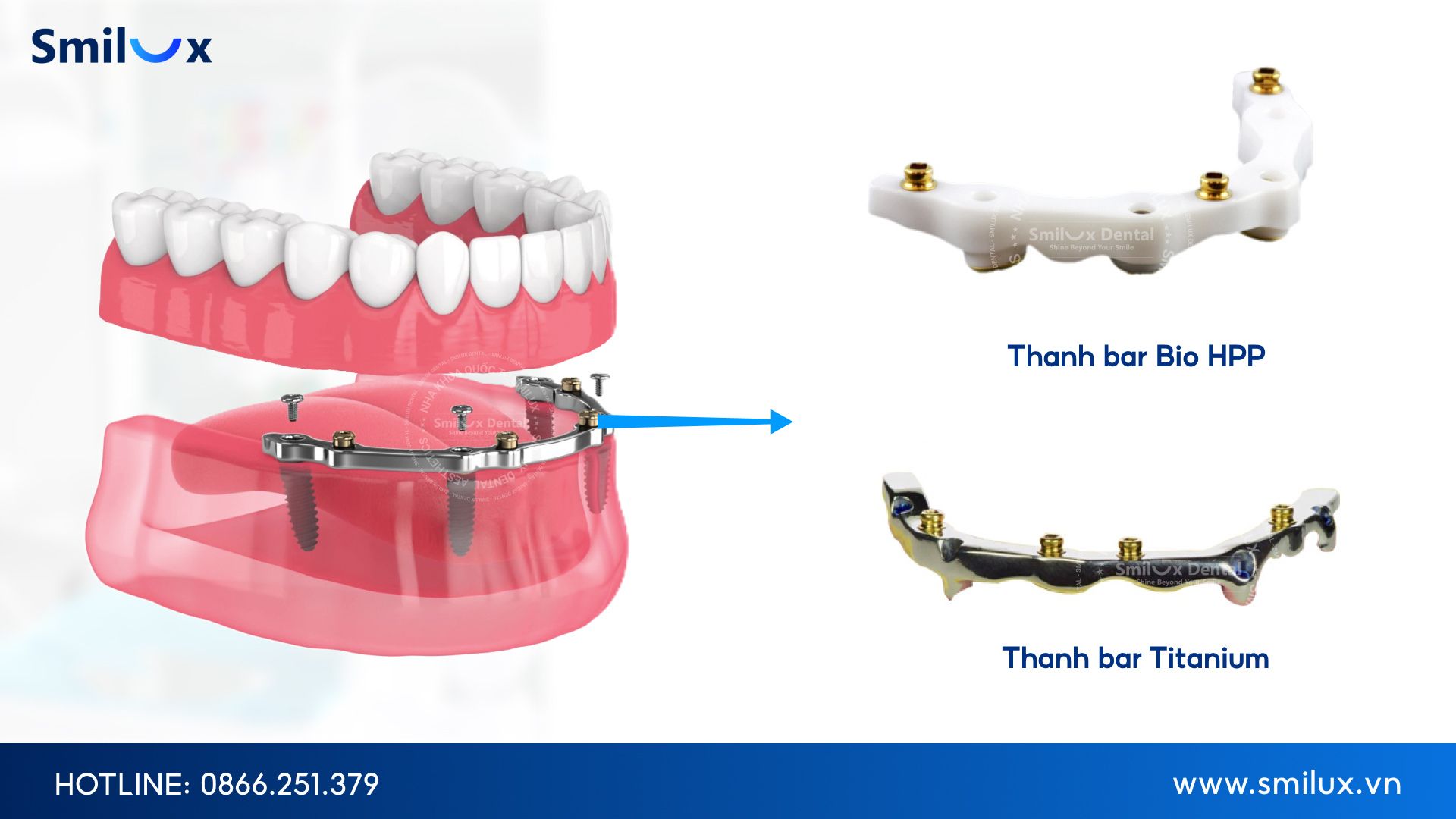
  • Thanh bar với công dụng nâng đỡ và tản đều lực nhai trên implant Bar with the function of supporting and evenly distributing chewing force on the implant

Which Full-Arch Implant Prosthetic Teeth Should You Choose?

After full-arch implant placement, choosing the type of prosthetic teeth is a crucial step. Common options include Composite Resin Teeth, Metal-Porcelain Fused to Metal (PFM) Teeth, and Full Zirconia/All-Ceramic Teeth, all attached to a Titanium or Bio HPP bar. Below are the pros, cons, and costs based on real-world experience.

1. Răng nhựa

Resin composite teeth are light, easy to repair, and securely attached to a Titanium or Bio HPP bar.

  • Pros: Low cost, basic aesthetics, easy to restore, quick restoration time.
  • Cons: Prone to wear and staining after 3–5 years, poor load-bearing capacity with overly hot food (though durability is higher with meticulous care).

2. Chrome Cobalt Teeth

Chrome Cobalt Teeth can be used with either a Titanium or BioHPP bar, depending on choice and need.

  • Pros: Highly durable, good load-bearing capacity, mid-range cost. Strong chewing force and less likely to crack.
  • Cons: Potential for metal margin visibility if gums recede, less aesthetic compared to All-Ceramic.

3. All-Ceramic Teeth

Full-Ceramic teeth attached to a Titanium or Bio HPP bar.

  • Pros: High aesthetics, natural color like real teeth, resists staining over time. Highly chosen for their nearly perfect aesthetics.
  • Cons: High cost.

Nên chọn răng sứ trên Implant toàn hàm nào Which full-arch porcelain crown should I choose for my implants

If you are considering options and want the precise cost of Full-Arch Dental Implants, check the prices here! Or

Book appointment with Dr. Smilux for a free consultation

    Comparison table of dental crown types

    CriteriaComposite TeethChrome Cobalt TeethAll-Ceramic Teeth
    Suitable For– People who want quick, gentle chewing restoration.– People who want high durability, comfortable chewing, and reasonable cost.– People working in communication, arts, or media fields.
     – Elderly patients seeking fast, cost-effective restoration.– Suitable for those prioritizing function over absolute aesthetics.– Customers who want the highest aesthetics, durability, and absolute biocompatibility.
    Outstanding Advantages– Lowest price, lightweight, easy to repair.– Good load-bearing capacity, durable, reasonably priced.– Perfect aesthetics, bright and translucent like real teeth.
     – Fast recovery.– Suitable for daily chewing needs.– No gum darkening, no allergies.
     – Fairly natural chewing sensation. – Long-lasting color retention, excellent stain resistance.
    Limitations to Note– Prone to wear and staining after 3–5 years.– Potential for gumline darkening if gums recede.– Highest price among the options.
     – Poor load-bearing capacity when chewing overly hard or hot foods.– Less natural color than Full-Ceramic. 
     – Shorter lifespan than ceramic.– May cause mild allergies in metal-sensitive individuals. 

    To explore specific services further, you can continue reading about What Smilux’s Full-Arch Implant Placement Offers? Where we share real patient experiences and modern technology.

    FAQs

    How do All-on-4 and All-on-6 Full-Arch Implants differ in terms of recovery time?

    All-on-4 and All-on-6 implant restorations typically require the same bone integration time, ranging from 3 to 6 months. There is no difference in recovery time. This depends on the individual's biological response and how each customer cares for their oral hygiene.

    Who should choose All-on-6 instead of All-on-4?

    The choice between All-on-4 and All-on-6 cannot be made subjectively but depends on many factors, such as bone density, gum condition, and the extent of bone loss. Cases requiring high stability or stronger chewing ability are usually prioritized for All-on-6 by the doctor. However, the final decision must be based on the CT scan and professional evaluation to select the most suitable solution for each customer.

    How much does the cost of All-on-4 and All-on-6 differ?

    All-on-4 is typically 20-30% cheaper than All-on-6 due to fewer posts, but the total cost also depends on the type of prosthetic teeth and the bar used.
    This site is registered on wpml.org as a development site. Switch to a production site key to remove this banner.