If you’re still unsure about the right time to choose full-arch dental implant restoration, check out this article: When Should You Opt for Full-Arch Dental Implants?
MỤC LỤC (TABLE)
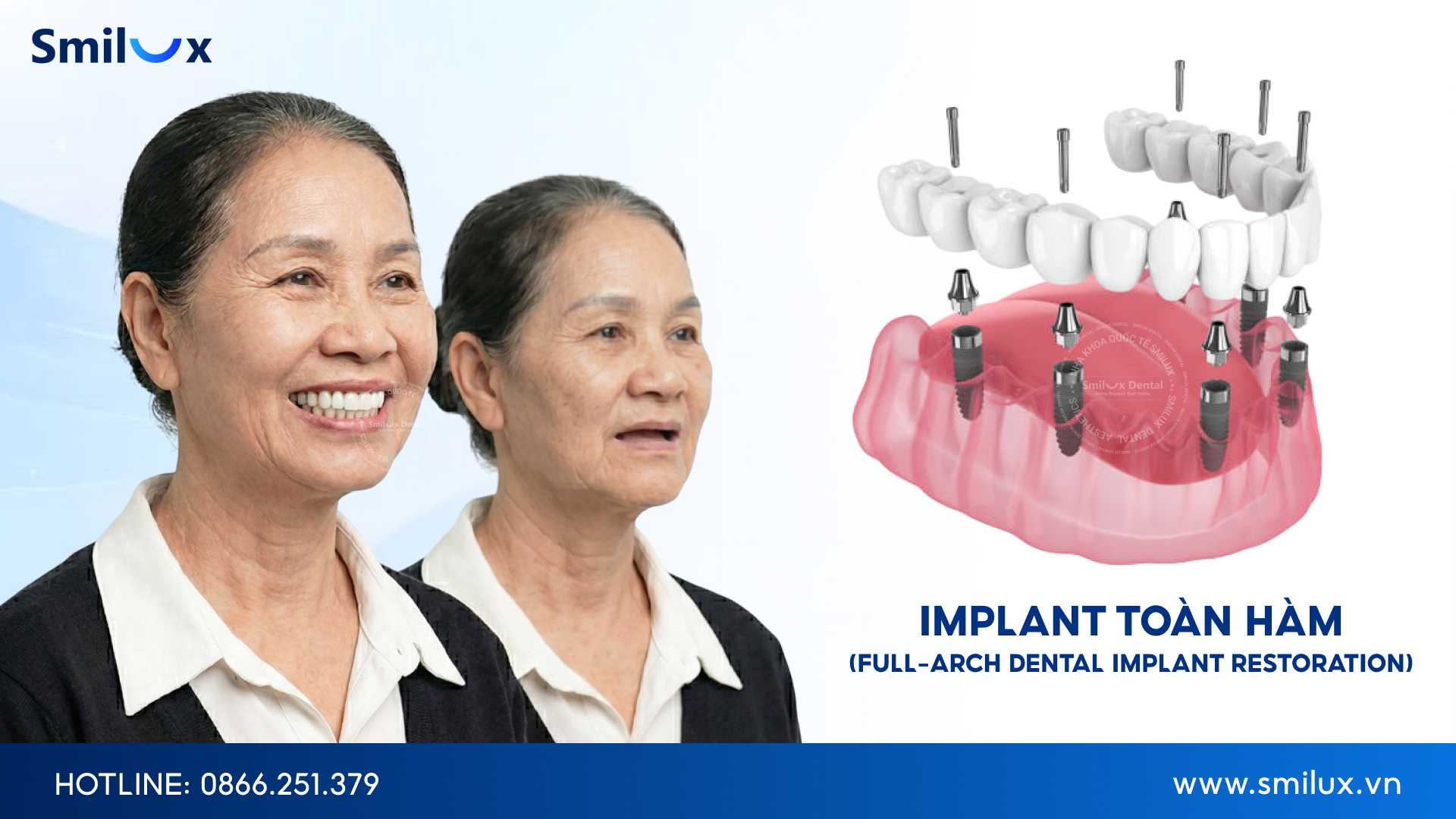
ToggleFull-arch dental implants are the most advanced solution for restoring an entire arch of missing teeth. With only 4–6 implants combined with an international-standard supportive bar, patients can regain strong chewing function comparable to natural teeth, along with superior aesthetics and long-term durability compared with traditional dentures.
However, not everyone is an ideal candidate. At Smilux, dentists evaluate patients based on the following three scientific criteria to determine whether full-arch implants are the optimal choice.
Before full-arch implant placement, patients undergo a comprehensive health evaluation to ensure the body can heal and support the implants:
If these conditions are well-controlled, the dentist can still perform implant placement with an appropriate treatment plan.
The jawbone is the decisive factor for implant success. Only when bone density and volume meet the necessary requirements can implants integrate quickly and firmly. At Smilux, dentists evaluate the following three criteria using 3D CT ConeBeam imaging:
1. Bone Quantity
Adequate height and thickness
Length ≥ 6 mm
Width ≥ 3 mm
2. Bone Quality (Based on Hounsfield Units)
D1 (>1250 HU): Very dense, limited blood supply
D2–D3 (350–1250 HU): Ideal, dense and well-vascularized
D4 (<350 HU): Soft, requires advanced techniques
HU (Hounsfield Unit) | Bone density measurement |
| D (Density) | Bone quality classification |
| D1 | Bones are very dense and hard |
| D2 – D3 | Bones are strong, elastic and have many blood vessels |
| D4 | Bones are soft and spongy |
3. Bone Loss
For patients with bone resorption, autogenous or artificial bone grafting can be performed to rebuild adequate bone volume for stable implants.
From 18 years and older, the jawbone is fully developed and can safely receive implants. Lifestyle Factors Affecting Success
Patients who maintain good habits and follow postoperative instructions have a 98-99% success rate, with implant longevity lasting decades or even a lifetime.
At Smilux, the OTI magnetic-guided implant system includes five components: Implant – Abutment – Ticylinder – Prosthetic Teeth – SSE Titanium Screw System. It uses dual screw-retained technology, ensuring stability without incisions or pain.
Combined with MagSense™ magnetic resonance sensing, dentists can determine the “golden timing” for immediate restoration, making the process significantly more comfortable than traditional methods.
After implant placement, patients select the bar system, an exclusive Smilux technique that connects all implants, distributes chewing forces evenly, and enhances overall durability.
Finally, Smilux designs the full-arch prosthesis based on facial proportions, tooth shape, tooth shade, and age to ensure a natural, harmonious smile.
Ideal for:
Advantages:
Limitations:
⇒ Read more about full mouth dental implant costs at Smilux
Book appointment with Dr. Smilux for a free consultation
Ideal for:
Advantages:
Limitations:
Ideal for:
Advantages:
Limitations:
Highest cost among all restoration materials
| Criteria | Resin Teeth | PFM Teeth | Full Zirconia |
| Aesthetics | Good but stains easily | Good, slightly opaque | Excellent, natural |
| Durability | 5-7 years | 7-10 years | 20+ years or lifetime |
| Chewing Performance | Good | Strong but heavy | Excellent, strongest |
| Biocompatibility | Good | Possible metal allergy | Excellent |
| Repair | Easy | Easy | Easy |
| Cost | Low | Medium | High |
| Best For | Budget-friendly | Balanced durability & cost | Best results & lifetime use |
If you’re still unsure about the right time to choose full-arch dental implant restoration, check out this article: When Should You Opt for Full-Arch Dental Implants?
1. Can older adults with medical conditions get implants?
Yes. As long as underlying conditions are well-controlled under medical supervision.
2. Can severe bone loss still receive implants?
Yes. Full-arch implants (4-6 implants) utilize remaining bone. Bone grafting can also be performed when necessary.
3. How do resin vs. PFM vs. zirconia teeth compare?
Resin: Good but wears fast
PFM: Strong but slightly heavy
Zirconia: Strongest, most aesthetic, best long-term choice
CONTACT