What Is a Temporary Crown on Implant? Functions, Types, and Procedure

When researching dental implant treatment, most patients tend to focus only on the implant fixture, abutment, and dental crown. Meanwhile, the Temporary crown on Implant is rarely mentioned, despite playing an important role during the waiting period before the permanent restoration is placed.

So, what is a Temporary crown on Implant, how long is it used, and how should it be cared for? Join the dentists at Smilux Dental International Clinic as they provide a detailed explanation in the article below.

What Is a Temporary Crown on Implant? Functions, Types, and Procedure

What Is a Temporary Crown on Implant?

A Temporary crown on Implant is a provisional restoration attached to the implant fixture or abutment while the permanent dental crown is being fabricated. It is designed to closely resemble a natural tooth, helping cover the gap left by the missing tooth, maintain aesthetics, and support light chewing during the osseointegration period.

Unlike a permanent ceramic crown, a temporary crown is usually made from hard resin, acrylic, or composite materials, so its durability and load-bearing capacity are limited. Therefore, patients should use it only for light chewing and avoid biting hard or chewy foods or placing excessive pressure on the newly implanted area.

Once the implant has become stable and the permanent ceramic crown has been completed, the dentist will remove the temporary crown and replace it with the definitive restoration. This completes the dental implant procedure and helps restore chewing function, aesthetics, and long-term durability.

Răng tạm trên Implant là phục hình tạm thời được gắn lên trụ Implant hoặc Abutment trong thời gian chờ lắp mão răng sứ cố định

Functions of a Temporary Crown on Implant

A Temporary crown on Implant serves as an intermediate “bridge” between implant placement and the attachment of the permanent ceramic crown. Although it cannot replace the definitive restoration and is used only while the implant integrates with the jawbone, it still performs several important functions:

  • Maintaining temporary aesthetics: The temporary crown fills the gap left by the missing tooth, reducing the appearance of a visible space when smiling or speaking, especially in the anterior region.
  • Supporting gum contouring: In some cases, the temporary crown helps shape the gum tissue and create a more harmonious gingival contour before the permanent ceramic crown is placed.
  • Protecting the implant site: The temporary crown helps cover the treated area and limit direct impact on the newly placed implant, supporting a more stable healing process.
  • Supporting light chewing: Patients may use the temporary crown for light chewing. However, they should avoid very hard or chewy foods and excessive pressure on the implant site.
  • Maintaining confidence in daily activities: For missing teeth in visible areas, the temporary crown allows patients to communicate, work, and carry out daily activities more comfortably while waiting for the permanent restoration.

Răng tạm trên Implant giúp duy trì thẩm mỹ, định hình nướu, bảo vệ vùng cấy ghép

When Is a Temporary Crown on Implant Needed?

Not every patient undergoing dental implant treatment needs a temporary crown. However, in certain situations, the dentist may require one to maintain aesthetics, protect the implant site, and make daily activities more convenient for the patient.

After the implant fixture is placed in the jawbone, it usually takes approximately 3-6 months to achieve stable osseointegration before the final ceramic crown can be attached. During this period, a Temporary crown on Implant is commonly indicated in the following cases:

  • Patients who have lost a front tooth or a tooth in a visible area and need to conceal the gap when smiling or speaking.
    Patients who have lost multiple posterior teeth or all teeth in one arch and require a provisional restoration to support daily activities.
    Cases that require shaping or reconstructing the gum tissue before the permanent crown is placed.
    Cases in which the appropriate space must be maintained to prevent adjacent teeth from tilting into the missing-tooth area.
    Cases in which the dentist needs to assess the shape, size, and overall harmony of the crown before completing the definitive restoration.

Types of Temporary Crowns and Dentures on Implants

Depending on the patient’s oral condition, the location of the missing teeth, and the planned restoration, the dentist will select the most appropriate type of temporary crown or denture. Temporary restorations on implants are currently divided into the following common types:

Classification by Method of Use

  • Resin-Bonded Temporary Tooth

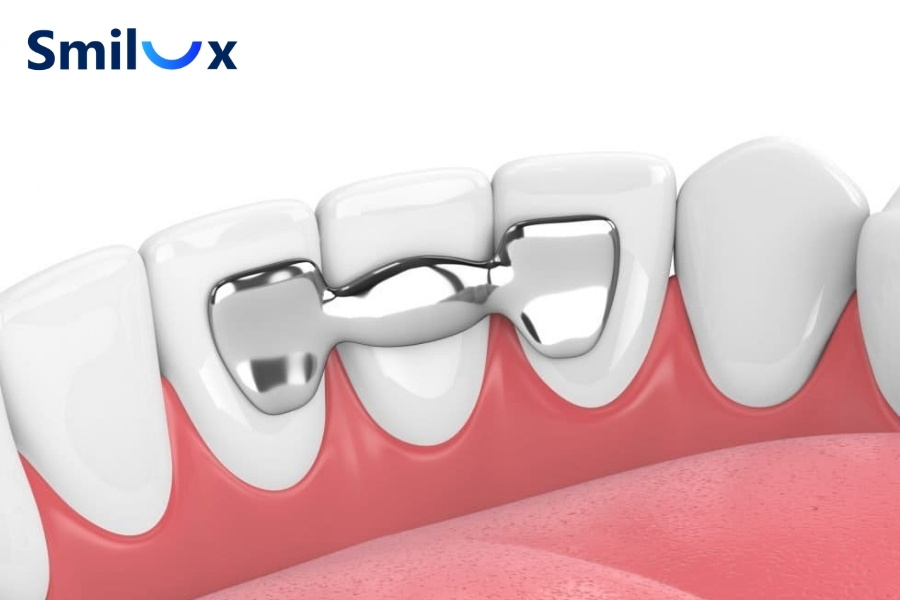
This type of temporary restoration is commonly used for patients missing one or two teeth in the aesthetic zone, particularly the front teeth. The temporary tooth is bonded to the inner surfaces of the adjacent teeth, covering the edentulous space without requiring removal. The procedure is relatively quick and usually takes approximately 15-30 minutes.

  • Removable Temporary Tooth or Denture

This option is suitable for patients with multiple non-adjacent missing teeth or those who are unable to use a resin-bonded temporary tooth. The dentist may adjust an existing removable denture if it remains suitable or fabricate a new temporary denture for use while the patient waits for the definitive restoration. The procedure usually takes approximately 30-45 minutes.

  • Fixed Temporary Crown on Implant

A fixed Temporary crown on Implant is attached directly to the implant when sufficient primary stability and suitable jawbone quality have been achieved. This type of temporary restoration is often preferred in the aesthetic zone because it provides greater stability, is easier to clean, and offers better support for chewing than a removable denture. The procedure usually takes approximately 15-30 minutes.

Fixed Temporary Dental Bridge

A temporary dental bridge is commonly used when the edentulous area is not too extensive and the adjacent teeth are already crowned or scheduled for restorative treatment. This option helps maintain aesthetics, preserve the required restorative space, and support daily activities while the patient waits for the final ceramic restoration. The procedure usually takes approximately 30-45 minutes.

  • Same-Day Temporary Denture with All-on-4/All-on-6

In certain full-arch restoration cases using the All-on-4 or All-on-6 implant technique, patients may receive a temporary denture on the same day, provided that the jawbone condition and initial implant stability meet the required criteria.

Răng tạm hình cánh dán

Classification by Fabrication Material

  • Acrylic Temporary Crown

An acrylic temporary crown is made from lightweight acrylic resin, which is easy to fabricate and relatively affordable. One advantage of acrylic is that it can be easily adjusted when occlusal correction is needed, making it suitable for many patients.

However, this material is not highly durable and may chip or crack under excessive chewing forces. Its color is also less natural than that of a permanent ceramic crown and may become stained after a period of use.

  • Composite Temporary Crown

A composite temporary crown is fabricated from composite resin, a material commonly used for aesthetic dental fillings. Compared with acrylic, composite offers a shade that blends more harmoniously with natural teeth, a smoother and glossier surface, and greater hardness. Therefore, this type of temporary crown is often suitable for cases in which aesthetics must be maintained while waiting for the permanent ceramic crown.

Although composite temporary crowns are more durable than acrylic crowns and more resistant to staining, they are also more expensive, require greater technical precision during fabrication, and may still become discolored if not properly cared for.

  • PMMA Temporary Crown

A PMMA temporary crown is commonly fabricated using CAD/CAM technology, providing greater accuracy, durability, and aesthetics. PMMA has a relatively natural appearance, is less prone to fracture than conventional temporary materials, and can be used for an extended period.

Its disadvantages include higher cost and the need for specialized equipment and precise fabrication techniques.

Procedure for Fabricating a Temporary Crown on Implant

At Smilux, the entire process of fabricating a Temporary crown on Implant is directly performed and supervised by highly qualified dentists to ensure appropriate indications and patient safety.

  • Step 1: Examination and Assessment of the Jawbone Condition

Before fabricating the temporary crown, the dentist will examine the missing-tooth area, jawbone condition, gum tissue, and the stability of the implant fixture after placement. This assessment helps determine whether the patient needs a temporary crown.

  • Step 2: Selecting the Appropriate Temporary Restoration Method

Depending on the patient’s condition, the dentist will recommend the most suitable method. With the conventional approach, the temporary crown is usually shaped directly from composite resin after implant placement. With the digital approach, the dentist will take a digital impression using a 3D scanner, plan the restoration using specialized software, and send the data to the dental laboratory for fabrication.

  • Step 3: Fabricating the Temporary Crown

When the temporary crown is fabricated chairside, the patient may receive it immediately after the treatment session. In contrast, a CAD/CAM temporary crown requires additional fabrication time.

  • Step 4: Placing the Temporary Crown and Adjusting the Occlusion

Once fabrication is complete, the dentist will place the temporary crown at the restoration site and assess its fit, shape, color, and occlusion. If there are any areas of discomfort, interference, or inappropriate biting pressure, the dentist will make the necessary adjustments to improve comfort during speaking and daily activities.

  • Step 5: Monitoring During the Waiting Period Before the Permanent Crown

After the temporary crown is placed, the patient should attend scheduled follow-up appointments so that the dentist can monitor healing, implant stability, and the condition of the surrounding gum tissue. Once the implant has firmly integrated with the jawbone, the dentist will remove the temporary crown and place the permanent ceramic crown.

Quy trình làm răng tạm trên Implant

Care Instructions and Important Considerations When Using a Temporary Crown on Implant

Although it is used only during the waiting period before the permanent restoration is placed, a Temporary crown on Implant still requires careful maintenance. Below are some detailed care instructions:

Cleaning and Caring for a Temporary Crown

Patients should brush gently with a soft-bristled toothbrush, especially around the Temporary crown on Implant and the implant fixture. Specialized dental floss or a water flosser set to an appropriate pressure may also be used to remove food debris and plaque, thereby reducing the risk of gingival inflammation.

Patients should not use hard wooden toothpicks or insert sharp objects around the temporary crown, as these habits may damage the gum tissue, cause bleeding, or loosen the provisional restoration.

Có thể sử dụng chỉ nha khoa chuyên dụng hoặc máy tăm nước ở chế độ nhẹ để làm sạch thức ăn thừa

Adjusting Eating Habits

While using a Temporary crown on Implant, patients should prioritize soft, easy-to-chew foods and cut food into small pieces before eating to reduce pressure on the temporary crown and the implant site while it is healing.

Hard, chewy, or sticky foods such as bones, hard nuts, gummy candies, and glutinous rice cakes should be limited. Patients should also avoid using their teeth to bite pens, open bottle caps, or chew ice. Because temporary crowns are usually made from acrylic resin or composite, they are less durable than permanent ceramic crowns and may crack, chip, or fracture more easily.

>>> READ MORE: What Is an Implant Abutment? Structure, Role, and Cost

Attend Follow-Up Appointments as Scheduled by the Dentist

After the Temporary crown on Implant is placed, patients should attend follow-up appointments as instructed so the dentist can assess the stability of the restoration, the condition of the gum tissue, and healing around the implant. The frequency of follow-up visits will be adjusted according to each patient’s implant condition and restorative treatment plan.

If you experience persistent pain, a loose temporary crown, discomfort when biting, swollen gums, or unusual bleeding, contact the dental clinic promptly for timely evaluation and treatment.

Bệnh nhân cần tái khám đúng lịch và liên hệ nha khoa sớm nếu xuất hiện đau nhức

Do Not Attempt to Repair a Broken Temporary Crown on Implant Yourself

Because it is less durable than a permanent ceramic crown, a Temporary crown on Implant may chip or fracture when subjected to excessive chewing forces. If this occurs, patients should not attempt to reattach it with adhesive, as the chemicals in the glue may irritate the soft tissues, alter the bite, or make professional repair more difficult.

BOOK APPOINTMENT

    CONCLUSION

    We hope the information above has provided you with a clearer understanding of the Temporary crown on Implant. For professional consultation on dental implant treatment and the appropriate use of a temporary crown, please contact Smilux Dental directly via HOTLINE (+84) 866 251 379.

    ---------- Implant Knowledge ----------

    Temporary crown on Implant
    08Jul

    A Temporary crown on Implant is a provisional restoration used while the dental implant integrates with the jawbone. In the article below, Smilux explains its functions, types, and placement procedure.

    Implant-supported removable denture
    06Jul

    An implant-supported removable denture is a restorative solution for patients who have lost multiple teeth or an entire arch, helping improve chewing function at a reasonable cost. Smilux dentists will explain what this treatment is, whether it is good, and how much it costs.

    What Is an Implant Abutment?
    05Jul

    Learn with Smilux Dental about What Is an Implant Abutment?, including its structure, classification, placement procedure, and the latest implant abutment price list.

    Structure of the Dental Implant
    04Jul

    Learn about the structure of the dental implant, including its components and the role of each part. Smilux dentists provide detailed explanations to help patients understand clearly before getting dental implants.

    1 2 3 6
    This site is registered on wpml.org as a development site. Switch to a production site key to remove this banner.