How Long After Tooth Extraction Can Dental Implants Be Placed?

Tooth extraction is usually the last option when a natural tooth has been severely damaged and can no longer be preserved. After tooth loss, dental implant placement is considered an ideal restorative solution because it helps restore chewing function similar to natural teeth while also preventing jawbone loss over time.

How Long After Tooth Extraction Can Dental Implants Be Placed? In the article below, dentists at Smilux Dental explain in detail the appropriate timing for dental implant placement. Please continue reading to learn more about this topic.

How Long After Tooth Extraction Can Dental Implants Be Placed?

How Long After Tooth Extraction Can Dental Implants Be Placed?

The timing of dental implant placement after tooth extraction varies depending on several factors, including the condition of the jawbone, the health of the gum tissue, and the healing process at the extraction site. Each stage of implant placement has its own clinical indications, which must be carefully evaluated by a dentist through a direct examination.

In most cases, the ideal time for dental implant placement is approximately 3 to 4 months after tooth extraction. However, some patients may be eligible for immediate implant placement right after the tooth is removed, while others may receive an implant within 1–2 months after extraction, depending on the healing condition and the quality of the surrounding bone.

Nhổ răng bao lâu thì trồng Implant được tùy thuộc vào tình trạng răng sau nhổ

Timeline for Dental Implant Placement After Tooth Extraction

Each timing option for dental implant placement after tooth extraction has its own advantages and limitations and is indicated for specific clinical situations. Determining how long after tooth extraction dental implants can be placed requires a thorough examination, radiographic imaging, and professional consultation with a dentist. This evaluation helps ensure proper implant integration with the jawbone, minimize potential complications, and maintain long term stability.

Below is a detailed analysis of the different timelines for dental implant placement following tooth extraction. Please refer to the sections below for further information.

Immediate Dental Implant Placement After Tooth Extraction

Placing a dental implant immediately after tooth extraction is known as immediate implant placement. This technique involves inserting the implant fixture into the jawbone during the same appointment as the tooth extraction, once the socket has been thoroughly cleaned and the bone and soft tissues meet the required clinical conditions.

Indicated Cases

  • Immediate implant placement may be considered when the following conditions are met:
  • The jawbone remains healthy, with adequate bone density (approximately 350–1250 HU), and is not excessively porous.
  • The walls of the extraction socket are intact and capable of supporting the implant fixture.
  • The soft tissue around the extraction site is healthy, without tearing or significant trauma.
  • The tooth scheduled for extraction does not present with acute infection or severe oral pathology.

Procedure

  • Step 1: The dentist removes the damaged tooth. After the root is extracted from the jawbone, an extraction socket is formed at the site.
  • Step 2: The dentist prepares the implant site by drilling and then places the titanium implant fixture into the jawbone.
  • Step 3: Bone graft material and a collagen membrane may be placed to support bone regeneration and facilitate healing.
  • Step 4: A temporary restoration is provided to maintain aesthetics and temporary chewing function. In many cases, a temporary crown is attached to the implant after approximately 3 days to complete the initial recovery stage.

Advantages

  • Reduces the number of surgical procedures, thereby shortening the overall treatment timeline.
  • Requires local anesthesia only once for both tooth extraction and implant placement.
  • Helps preserve bone structure and soft tissue, reducing the risk of jawbone resorption after tooth loss.
  • Minimally invasive, and in many cases does not require a gum flap incision.

Limitations

  • The initial stability of the implant may be lower compared with implants placed after complete bone healing, as bone resorption following extraction can be difficult to predict.
  • The indications are relatively limited, and the technique is only suitable when the extraction socket is not too large and sufficient bone volume remains.
  • Additional bone grafting and collagen membrane placement are often required to support bone regeneration, which may increase the overall treatment cost.

Cấy ghép Implant tức thì

Dental Implant Placement 1–2 Months After Tooth Extraction

In cases where the extraction socket is not fully intact after tooth removal, dentists often recommend waiting approximately 1–2 months before placing a dental implant. This period allows the gum tissue and surrounding bone to begin healing, helping stabilize the extraction site, reduce the risk of infection, and create more favorable conditions for implant placement.

Indications

  • Dental implant placement after 1–2 months may be considered when the following conditions are present:
  • The soft tissue at the extraction site has partially healed, with no signs of infection.
  • The jawbone still maintains sufficient volume and density to support and stabilize the implant fixture.

Procedure

  • Step 1: The dentist performs a minimally invasive tooth extraction, limiting gum flap incisions and thoroughly cleaning the extraction socket.
  • Step 2: After approximately 1–2 months, once the gum tissue has covered the extraction site, the dentist places the implant fixture. If the jawbone lacks sufficient volume, bone grafting and collagen membrane placement may be performed to support bone regeneration.
  • Step 3: The soft tissue is sutured, and the implant is left to integrate with the jawbone while the gum tissue continues to heal.
  • Step 4: Once the implant has successfully integrated with the bone, the dentist takes impressions and places the final dental crown on the implant.

Advantages

  • Lower risk of infection compared with immediate implant placement, as the soft tissue at the extraction site has partially healed.
  • Provides the dentist with additional time to evaluate healing and bone resorption before implant placement.
  • Compared with waiting 3–4 months, the 1–2 month timeline shortens treatment duration while still allowing necessary healing.
  • Jawbone resorption is still limited, making implant placement more favorable.

Limitations

  • The extraction socket is still undergoing bone regeneration, so the bone may not yet have reached optimal density and strength.
  • Bone resorption may continue, and in some cases bone graft surgery may still be required to ensure sufficient bone volume for implant placement.

Dental Implant Placement 3–4 Months After Tooth Extraction

Dental implant placement 3–4 months after tooth extraction is commonly recommended when the extracted tooth had extensive infection, significant damage to the alveolar bone, or large tooth roots that leave the remaining bone walls relatively thin.

Placing the implant at this stage allows the extraction site to heal more completely, which helps reduce the risk of infection and minimize gum recession. In addition, the improved healing conditions enable the dentist to place the implant more precisely, ensuring better implant stability and long-term aesthetic outcomes.

Trồng răng Implant sau 3 - 4 tháng nhổ răng

Dental Implant Placement 6 Months After Tooth Extraction

Approximately 6 months after tooth extraction, the jawbone is typically more stable and well healed. At this stage, dentists can proceed with dental implant placement with a higher level of safety while minimizing the risk of potential complications.

This waiting period may also allow patients additional time to prepare financially and plan for the implant procedure and the subsequent restoration phase, which helps restore normal chewing function.

In addition to the question “How Long After Tooth Extraction Can Dental Implants Be Placed?”, many patients are also concerned about whether dental implants can still be placed after long term tooth loss.

To better understand this situation, you may refer to the article “Can Dental Implants Be Placed After Long Term Tooth Loss?” for more detailed information and important considerations before undergoing treatment.

Advice from Smilux Dental Specialists

To determine how long after tooth extraction dental implants can be placed based on your individual condition, it is best to undergo a professional examination with a qualified dentist. Through clinical evaluation and diagnostic imaging, the dentist will assess the healing condition of the gum tissue, the status of the jawbone, and bone density to select the most appropriate timing for implant placement, ensuring both safety and long term effectiveness.

Immediate implant placement can only be performed right after tooth extraction. If the tooth was removed 1–2 months earlier, the dentist will reassess the bone density. If the jawbone remains in good condition, dental implant placement can still be carried out. However, when more than 3 months have passed since extraction, the risk of jawbone resorption is typically higher, and many patients may require bone grafting before implant placement.

According to the clinical experience of dentists at Smilux Dental, the success rate of dental implants is nearly comparable across different timing approaches, including immediate implant placement, early implant placement after 1–4 months, and delayed implant placement after 4–12 months. The most important factor is choosing the right timing based on the patient’s jawbone condition, which helps achieve long term stability and optimal aesthetic results.

Cô/chú/anh/chị nên thăm khám cùng bác sĩ để biết chính xác thời điểm nên trồng răng Implant

Safe Dental Implant Placement with Fast Recovery at Smilux Dental

Smilux Dental is not only a trusted clinic for tooth extraction and dental implant treatment, officially licensed by the Ministry of Health, but also a pioneer in applying advanced technologies in implant dentistry. With a team of dentists who have over 15 years of clinical experience, Smilux Dental is committed to providing patients with safe, minimally painful procedures, shorter treatment time, and faster recovery of chewing function after implant placement.

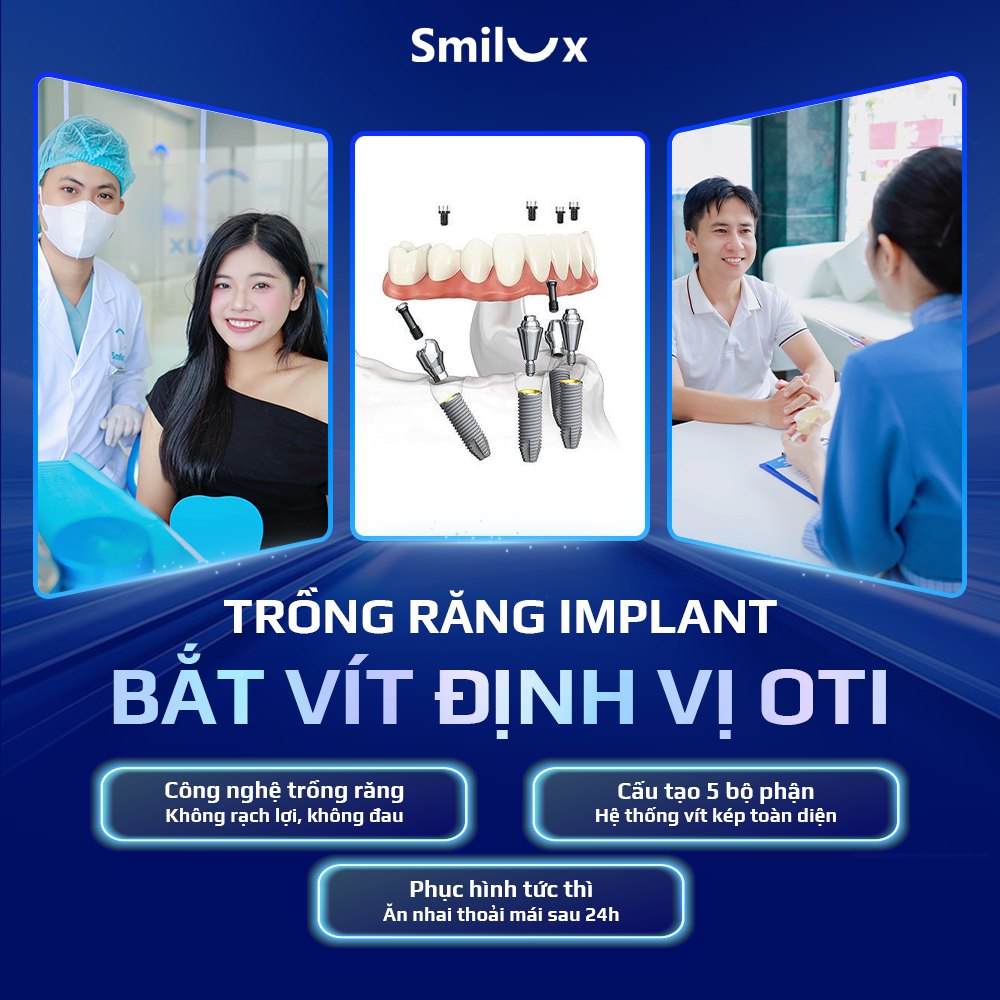
  • OTI Screw Retained Implant Technology: This exclusive OTI technology utilizes a specialized implant system consisting of five components: the implant fixture, abutment, Ticylinder, dental crown, and the SSE titanium screw system. These components are connected through two screw systems from top to bottom, creating a highly stable and durable prosthetic structure for long term restoration.
  • Cone Beam CT 3D Imaging System: The Cone Beam CT scanner enables dentists at Smilux Dental to reconstruct three dimensional images of the teeth and jawbone. This technology allows accurate assessment of bone density, nerve location, and jawbone structure before implant placement, helping dentists develop a precise treatment plan while ensuring patient safety.
  • MagSense Magnetic Resonance Stability Technology: The MagSense technology analyzes magnetic resonance frequency to monitor the stability of the implant fixture within the jawbone. This allows dentists to determine the optimal timing for placing the final prosthetic restoration on the implant, improving bone integration and ensuring long term stability. As a result, patients can achieve more predictable treatment outcomes and faster restoration of normal chewing function.

With the support of advanced technologies, dental implant treatment at Smilux Dental is performed with high precision, safety, and long term effectiveness.

Please leave your information in the form below so that the dentists at Smilux Dental can contact you for a free consultation and develop a personalized dental implant treatment plan based on your specific condition.

BOOK APPOINTMENT

    CONCLUSION

    In summary, How Long After Tooth Extraction Can Dental Implants Be Placed? depends on several factors. Implant placement may be performed immediately after extraction, 1–2 months later, or at a later stage if additional healing time is required for the jawbone.

    If you are considering dental implant treatment, please contact Smilux Dental via HOTLINE (+84) 66 251 379 for a free consultation and to schedule an appointment with a dentist at your earliest convenience.

    ---------- IMPLANT ----------

    Can I get implants with gum disease?
    19Mar

    Can I get implants with gum disease? Let’s explore this topic in detail with Smilux Dental to better understand whether patients with periodontal disease can receive dental implants before making a decision to restore chewing function with implant treatment.

    Can people with diabetes get dental implants?
    18Mar

    Diabetes and dental implants is a common concern among many patients who are experiencing tooth loss but feel hesitant due to underlying health conditions. At Smilux Dental, we understand these worries and aim to provide clear, professional guidance. Let’s explore this topic in detail in the article below.

    Can you drink beer after getting dental implants?
    17Mar

    Can you drink beer after getting dental implants? According to recommendations from Smilux Dental, patients should avoid drinking beer or alcohol both before and after dental implant placement.

    How Long After Tooth Extraction Can Dental Implants Be Placed?
    16Mar

    How Long After Tooth Extraction Can Dental Implants Be Placed? According to dentists at Smilux Dental, the ideal time to place a dental implant is typically 3–4 months after tooth extraction. However, in some cases, implant placement may be performed earlier depending on the condition of the extraction site and the patient’s oral health.

    1 2 3 5
    This site is registered on wpml.org as a development site. Switch to a production site key to remove this banner.