1. Home
  2. »
  3. Implants Knowledge
  4. »
  5. Can I get implants with gum disease?

Can I get implants with gum disease?

Periodontal disease leading to early tooth loss is a common condition. Once teeth are lost, many patients begin seeking dental implants to restore chewing function and aesthetics.

However, many patients still wonder, “Can I get implants with gum disease?”, and whether the procedure is truly safe. In the article below, Smilux Dental will provide a detailed explanation of this issue.

Can I get implants with gum disease?

Overview of periodontal disease

Before answering the question “Can I get implants with gum disease?”, Smilux Dental will first provide a general overview of periodontal disease.

Periodontal disease is a progressive gum infection that directly affects the soft tissues and the supporting bone around the teeth. It typically develops from untreated gingivitis caused by plaque buildup and bacterial accumulation over time.

In the early stages, patients may notice symptoms such as bleeding gums when brushing, redness, swelling, or persistent bad breath. As the condition progresses, the gums begin to recede, exposing the tooth roots and making the teeth more sensitive and noticeably loose.

If left untreated, periodontal disease gradually destroys the jawbone structure, leading to bone loss and eventually permanent tooth loss. This is also a common reason why many people lose teeth even without tooth decay.

Periodontal disease not only affects aesthetics and chewing function but also serves as a warning sign of deteriorating oral health, requiring prompt examination and appropriate treatment.

Viêm nha chu là bệnh lý răng miệng nghiêm trọng xảy ra khi các mô nâng đỡ răng như nướu, dây chằng nha chu và xương ổ răng bị viêm nhiễm.

Can I get implants with gum disease?

Given the serious consequences of periodontal disease, many patients are concerned about whether they can still receive dental implants.

Addressing this concern, dentists at Smilux Dental explain:
“Patients with periodontal disease can still undergo dental implant placement. However, it is essential to control and stabilize the infection before the procedure. This ensures that the jawbone is healthy enough, reduces the risk of implant failure, and improves the success rate of osseointegration.”

Depending on the severity of periodontal disease, the level of bone loss, and the number of missing teeth, the dentist will recommend an appropriate treatment approach:

  • Mild periodontal disease: At this stage, treatment is relatively simple. The dentist will remove plaque and tartar buildup and eliminate bacteria around the gums. Once the gums return to a healthy condition, patients can proceed with restorative treatment.
  • Advanced periodontal disease with periodontal pockets: In this stage, bacteria have penetrated deeper beneath the gums and cannot be managed with routine cleaning. The dentist may perform scaling and root planing, periodontal pocket debridement, or flap surgery to thoroughly eliminate infection before considering implant placement.
  • Cases with bone loss and gum recession: This is a stage that concerns many patients due to the fear of insufficient bone for implant placement. In reality, bone grafting or soft tissue grafting can be performed to rebuild the jawbone foundation before placing the implant to ensure stability.
  • Severe periodontal disease with mobile, non-restorable teeth: When teeth can no longer be preserved, extraction is necessary to prevent the spread of infection. After that, the dentist will develop an appropriate implant treatment plan to restore chewing function and prevent further bone loss.

Bị nha chu có trồng răng Implant được không? Câu trả lời là CÓ

How long after periodontal treatment can dental implants be placed?

Typically, after about 1–2 weeks of treatment, once the gums have stabilized and there are no signs of inflammation such as swelling, bleeding, or pain, the dentist can begin planning the implant procedure step by step.

However, in cases of severe periodontal disease or significant bone loss, the waiting period may be longer to ensure optimal conditions for safe and successful implant placement.

Điều trị nha chu bao lâu thì có thể cấy ghép Implant?

Safe and long-lasting dental implants at Smilux International Dental Clinic

If you are experiencing periodontal disease or have had missing teeth for a long time, there is no need to worry, as Smilux Dental offers safe and durable implant solutions tailored to each individual case.

Smilux Dental is proud to be a licensed implant center approved by the Department of Health, with a team of dentists who have over 15 years of experience treating cases ranging from simple to highly complex, supported by advanced and modern equipment.

When choosing implant treatment at Smilux Dental, patients receive a personalized treatment plan clearly outlined at each stage. From infection control, soft tissue management, and bone grafting (if necessary) to implant placement and final restoration, every step is closely monitored by the dentist. This ensures not only safety but also long-term stability and minimizes future complications.

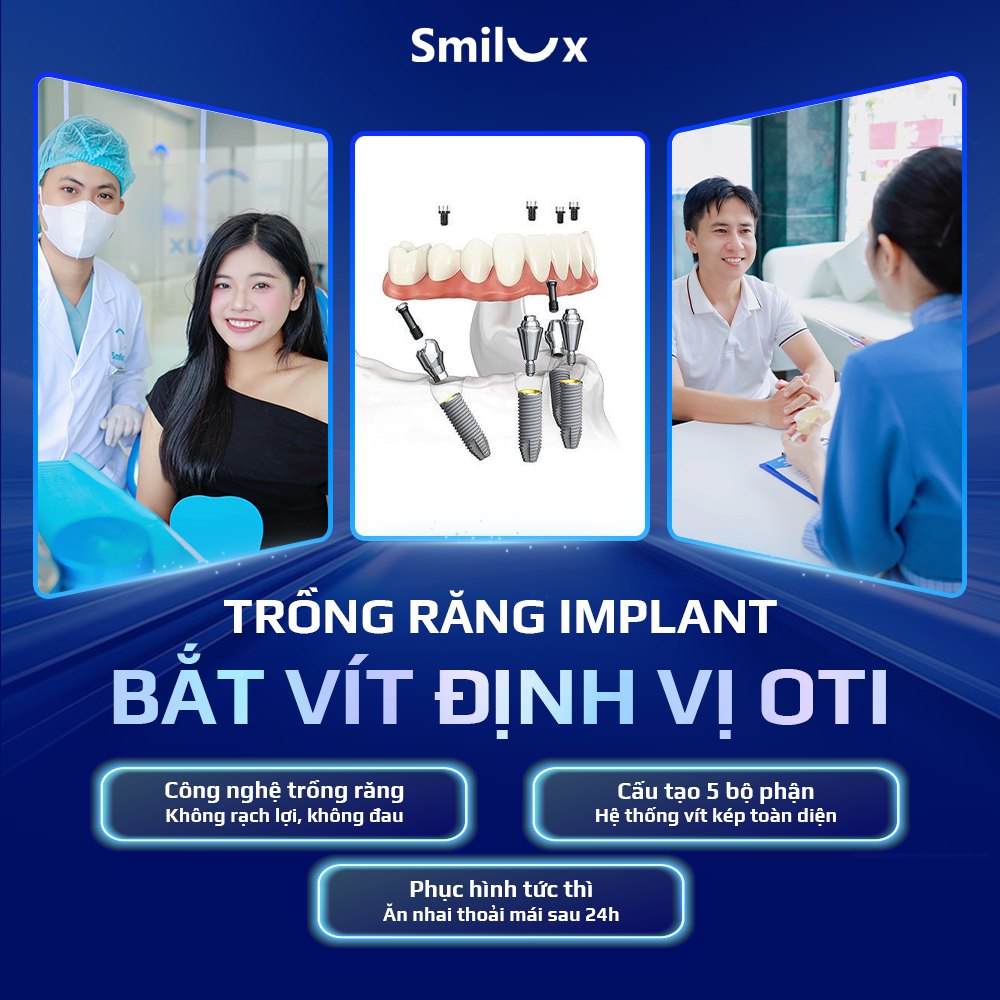
In particular, Smilux Dental is currently applying the OTI dental implant technique, which offers advantages such as being pain-minimized, flapless, enabling immediate restoration, and allowing early chewing function.

Unlike traditional methods that use cement retention, the OTI implant system utilizes a screw-retained mechanism with precise positioning. This allows the implant to be placed in the correct angulation, enhances stability, and provides better control during the prosthetic phase. In suitable cases, patients may receive early restoration and quickly regain chewing ability.

To accurately assess jawbone condition, the severity of periodontal disease, and suitability for dental implants, patients can leave their information in the form below. Dentists at Smilux Dental will directly evaluate and provide a personalized treatment plan tailored to each specific case.

BOOK APPOINTMENT

    CONCLUSION

    Hopefully, the information above has helped you gain a clear answer to the question of whether patients with periodontal disease can receive dental implants. In reality, implant placement is still possible when the infection is well controlled and the jawbone meets the required conditions.

    At Smilux Dental, every patient is provided with a personalized treatment plan to ensure stable and long-lasting results over time. Contact our HOTLINE at (+84)66 251 379 for detailed consultation.

    ---------- IMPLANT ----------

    Can I get implants with gum disease?
    19Mar

    Can I get implants with gum disease? Let’s explore this topic in detail with Smilux Dental to better understand whether patients with periodontal disease can receive dental implants before making a decision to restore chewing function with implant treatment.

    Can people with diabetes get dental implants?
    18Mar

    Diabetes and dental implants is a common concern among many patients who are experiencing tooth loss but feel hesitant due to underlying health conditions. At Smilux Dental, we understand these worries and aim to provide clear, professional guidance. Let’s explore this topic in detail in the article below.

    Can you drink beer after getting dental implants?
    17Mar

    Can you drink beer after getting dental implants? According to recommendations from Smilux Dental, patients should avoid drinking beer or alcohol both before and after dental implant placement.

    How Long After Tooth Extraction Can Dental Implants Be Placed?
    16Mar

    How Long After Tooth Extraction Can Dental Implants Be Placed? According to dentists at Smilux Dental, the ideal time to place a dental implant is typically 3–4 months after tooth extraction. However, in some cases, implant placement may be performed earlier depending on the condition of the extraction site and the patient’s oral health.

    1 2 3 5
    This site is registered on wpml.org as a development site. Switch to a production site key to remove this banner.